Roofing Company
Marketing Strategies
Practical marketing strategies for local roofing operations. Learn how high-growth contractors dominate paid search, local map pack listings, storm response, and customer relationship systems.

Which Roofing Marketing Investment Should Come First?
The right first move depends on where you are today. Use this as a starting point, then read the chapters below.
| Your situation | First move | Expand when | Go deeper |
|---|---|---|---|
| Few inquiries and no steady lead source | Local Service Ads and search ads on the services you want, plus tracked calls | Inquiries are tracked and booked inspections are steady | LSA, PPC |
| Plenty of inquiries but few booked inspections | Fix response speed, follow-up and tracking before adding spend | Most inquiries get a fast answer and a clear next step | CRM automation |
| Crews are booked out | Hold or trim acquisition; build reviews, recruitment and capacity | You can take on more inspections without losing quality | Recruitment marketing |
| Strong paid results but rising cost | Build local search and Maps visibility alongside paid | Organic inquiries start covering part of the volume | Local SEO |
| Storm-focused business | Prepare campaigns and capacity before the season | Readiness checks are agreed with you | Storm season |
| Commercial specialist | Targeted search, outreach and nurturing | Qualified opportunities appear in a defined pipeline | Commercial |
Budgeting and agency-cost guides are planned and will be linked here when published.
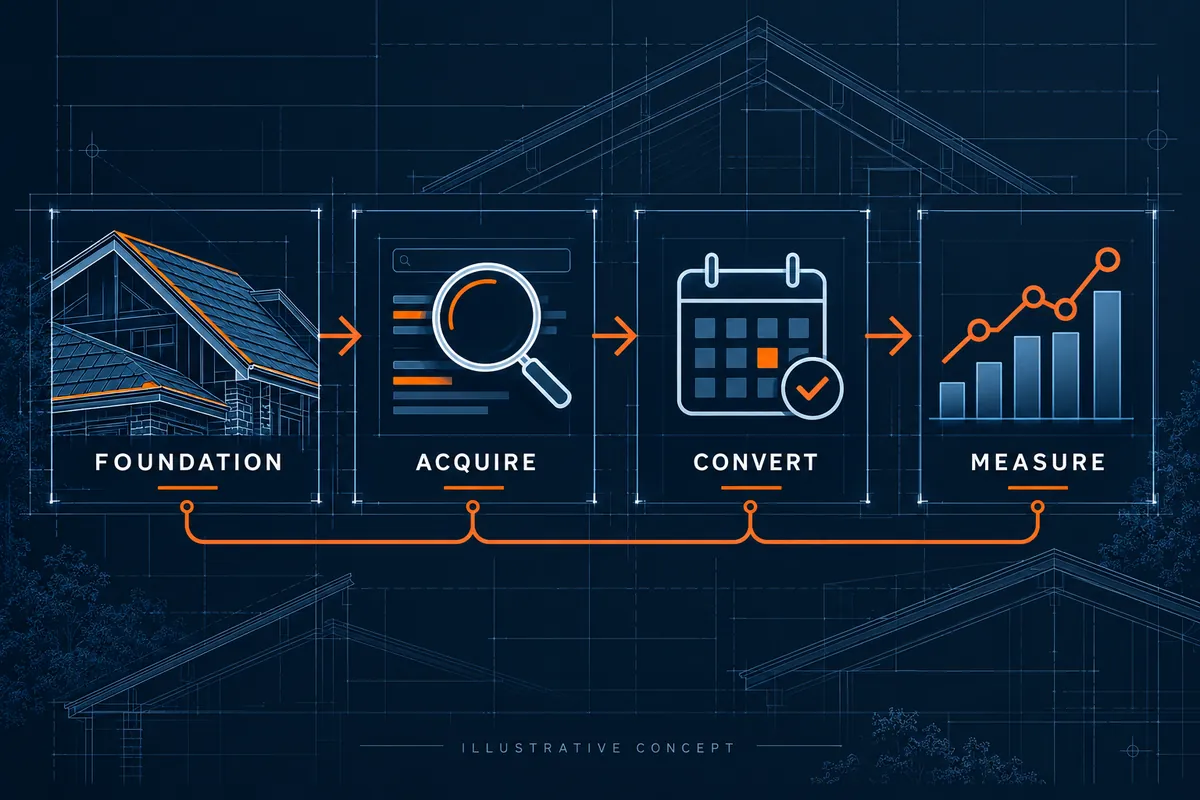
Four Questions Behind Every Roofing Marketing Plan
Foundation: is your business information accurate and your tracking in place?
Acquire: which channels fit your market, capacity and budget?
Convert: do inquiries get a fast answer and a clear next step?
Measure: can you see booked inspections and signed jobs by source?
The chapters below take each in turn.
The Roofing Growth Playbook
A data-driven roadmap to build a predictable client acquisition engine. We outline the math, the metrics, and the pitfalls of scaling your roofing business.
Local Map Pack Proximity Strategy
Local map results sit at the top of many local searches. To rank in the high-value Google 3-Pack, your business must establish strong signals across three pillars: proximity, relevance, and prominence.
Many contractors try to game the system by adding extra keywords to their business names (e.g. "Dallas Shingle Repair Pros"). While this can provide a short-term ranking boost, it is a direct terms-of-service violation. Competitors frequently flag stuffed listings using Google's Business Redressal Form, leading to immediate profile suspensions.
Instead of risky naming tricks, sustainable proximity rankings are built by securing high-authority directories, building local citations, and automating review generation. Continuous review velocity (getting steady, new ratings containing location-specific keywords) tells Google's algorithm that your company is the active, trusted choice in that market.
Core Metrics
High-Intent Transactional Search Funnels
When a homeowner has an active leak or storm damage, their search is immediate. Bidding on high-intent terms like "emergency roof repair" or "local shingle replacement" puts your brand in front of buyers at the exact moment of demand.
However, paid search is highly competitive, with click costs that vary widely by market and keyword. Running ads without narrow target lists and negative keyword exclusions will quickly burn through your budget on generic queries like "how to patch a flat roof DIY" or "roofing jobs near me."
To convert high CPC traffic into profitable jobs, you must route clicks to dedicated, single-topic landing pages optimized for mobile calls. We build target-specific pages that focus on a single service (e.g. hail damage replacement) and feature clear, direct calls-to-action, which usually convert better than a general homepage.
PPC Target Benchmarks
Neighborhood Hail & Wind Campaigns
Unlike retail roofing searches, storm restoration requires active, disruptive outbound marketing. When a severe hail storm hits, homeowners aren't immediately searching for contractors; they are assessing damage and figuring out insurance claim procedures.
Winning storm jobs requires a hyper-targeted neighborhood response. By pairing meteorological weather radar data with geographic audience coordinates on Facebook and Instagram, we can run campaigns in the areas where a storm was reported, inviting homeowners to book an inspection. A storm footprint shows possible exposure, not confirmed damage to any roof.
The trap of social media lead generation is low lead quality. Homeowners often submit forms accidentally or without realizing they need to own the property. We build pre-qualification logic directly into lead capture forms, filtering out renters and non-owners to ensure your sales team only calls qualified prospects.
Storm Parameters
Closed-Loop CRM & Speed-to-Lead
Generating high-intent traffic is only half the battle. The most common point of failure for roofing contractors is lead follow-up delays. If a prospect submits an inquiry and does not receive a response within 5 minutes, the chance of reaching that lead drops quickly.
Most roofing companies rely on office managers or estimators to manually call back new leads. Inevitably, calls are missed, emails sit in inboxes, and leads go cold while the homeowner moves on to call the next contractor on the search page.
High-growth roofing brands build an automation moat. When a lead enters the pipeline, database webhooks immediately trigger an automated SMS reply in under 60 seconds and place a direct call dialer to your staff. This rapid response locks in the prospect and secures the inspection before competitors can even review their inbox.
Response OS Stats
Talent & Crew Capacity Pipelines
The real cap on a roofing business's annual revenue isn't marketing demand — it is labor supply. Having too many sales leads is a liability if you don't have enough qualified sales estimators to run appointments, or experienced subcontractor crews to install the shingles.
High-performing contractors treat recruitment exactly like customer lead generation. Instead of posting generic job board ads when they are desperate, they run always-on recruitment funnels that continuously source, screen, and interview prospective reps and crew chiefs.
We set up dedicated recruitment ads and landing pages that highlight your company culture, pay structures, and crew logistics. Candidates go through automated screening surveys that pre-screen for valid driver's licenses, experience, and certifications, routing top-tier applicants directly to your calendar.
Hiring Metrics
The Shared Lead Platform Trap
Many roofing contractors rely on shared lead networks (like Angi, HomeAdvisor, or Networx) to fill their pipeline. The cost-per-lead looks cheap upfront, but the business model is built on selling that exact same lead to 4 or 5 of your local competitors simultaneously.
This creates a race to the bottom. Whichever contractor answers the phone first and offers the lowest price wins the job. Your margins are crushed, and you waste hours of estimation time bidding against low-cost competitors.
Building an owned lead generation asset (through localized PPC campaigns and Google Maps rankings) means every lead that calls you is exclusive to your business. There is no competition bidding against you on that specific lead, allowing your team to sell on value, protect high margins, and close more of the leads you receive.
Lead Comparison
Marketing Budget & ROI Simulator
Input your target metrics below to calculate required lead volume, closed sales, and target Return on Ad Spend (ROAS).
Get A Free Marketing Plan Review
We will look at your market, current lead sources and capacity, and recommend what to do first.
Related Guides From The Blog
- Common Roofing Marketing Mistakes and What to Do InsteadFrequent roofing marketing mistakes and fixes: no tracking, slow follow-up, too many channels, thin city pages, fake proof, ignoring reviews, overspending in storms, unclear agency terms and misreading reports.
- Roofing Marketing for a New Company: The First Six MonthsA six-month marketing plan for a new roofing company: foundations, reviews, local search, a first paid channel, referrals, tracking, budgets, common mistakes and what to expect.
- SEO or PPC First? Sequencing Search for a Roofing CompanyHow a roofing company should sequence SEO and PPC: speed versus durability, budget, competition, tracking, a staged plan and when to run both together.
- How to Tell if Your Roofing Marketing Is WorkingA practical way for roofing owners to judge marketing results: metrics that matter, what to ignore, a monthly review routine, red flags, how long to wait, and how to read an agency report.
- In-House Marketer or Agency? Questions to Ask Yourself FirstHow a roofing company can decide between hiring an in-house marketer, using an agency or combining both: scope, cost, skills, management, continuity, tools, control and a decision checklist.